Professor Wang Lingyun's research group has made significant progress in the conformal manufacturing of high-temperature thick-film sensors
Recently, the team led by Professor Wang Lingyun at the Sa BenDun Micro-Nano Science and Technology Research Institute of Xiamen University has achieved new progress in the field of conformal manufacturing of high-temperature thick-film sensors. Their work, titled "Piezoelectric-pneumatic material jetting printing for non-contact conformal fabrication of high-temperature thick-film sensors," has been published in the top additive manufacturing journal, Additive Manufacturing (IF 11.6). The research was funded by the National Key R&D Program (2022YFB3203900). Professor Wang Lingyun and Postdoctoral Fellow Wu Chao are the co-corresponding authors, and graduate student Zhou Xiong is the first author. In this study, the XMU-PJET5300R piezoelectric jetting printing system developed by Professor Wang Lingyun's research group was used. The piezoelectric jetting valve features a biomimetic integrated structure design with a 13-fold displacement amplification ratio, capable of high-viscosity jetting performance at a high frequency of 500Hz, significantly increasing the viscosity and solid content limits of printable pastes for existing non-contact jetting printing manufacturing methods. For the first time, the piezoelectric jetting valve has been applied to the conformal manufacturing of high-temperature thick-film sensors, achieving inkjet printing of dual-phase non-Newtonian fluid pastes. This has enriched the conformal additive manufacturing methods for thick-film sensors and successfully addressed a series of pain points in contact conformal printing, such as difficulties in printing path planning, slow printing speed, multi-material contamination, and film layer interference.
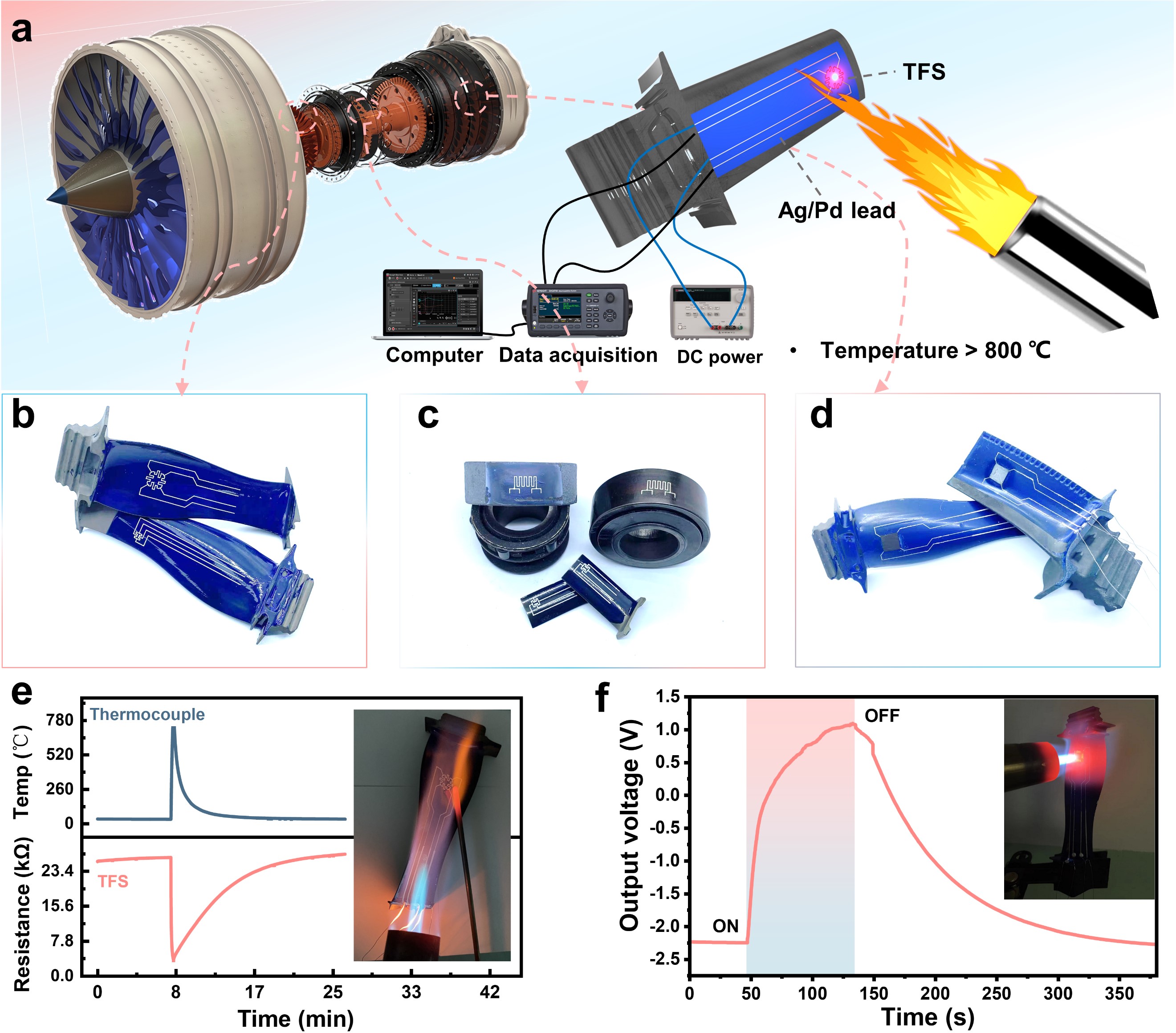
Schematic of piezoelectric-pneumatic material jetting conformal printing of high-temperature thin-film sensorsConformal thick-film sensors (TFS) can adapt to complex geometries and surfaces, which is crucial for in-situ sensing in extreme environments. However, traditional contact printing faces challenges in complex motion control on 3D surfaces. This study takes non-contact conformal printing as its core concept, using piezoelectric-pneumatic material jetting (PPMJ) to achieve rapid and uniform manufacturing of complex and multi-material conformal TFS. PPMJ has a wide printable viscosity range (50–100,000 mPa.s) and high solid content (60 wt%) printing performance, suitable for various types of inks from insulating materials to semiconductor materials and high-temperature alloy pastes, providing a rich operational window for shape control and performance modulation of conformal sensors on non-deployable surfaces. Polymer-derived ceramic heat flux sensors printed in-situ using the PPMJ process exhibit repeatable high-temperature response capabilities and, when integrated on the surface of turbine blades, can withstand thermal shocks from butane flames exceeding 800°C. The PPMJ printing technology opens up new possibilities for manufacturing various conformal sensors on complex 3D surfaces.
Application demonstration of conformal precursor ceramic high-temperature thin-film sensorsPrior to this, Professor Wang Lingyun's research group has been engaged in the design research of piezoelectric jetting valves for over a decade, continuously iterating high-performance versions. The publication of this achievement demonstrates the application prospects of self-developed equipment in our institute and indicates that our institute's research in the field of in-situ conformal additive manufacturing of functional devices has gained international recognition.

