Professor Hong Minghui's team at our institute has made new progress in the field of microsphere nano-imaging.
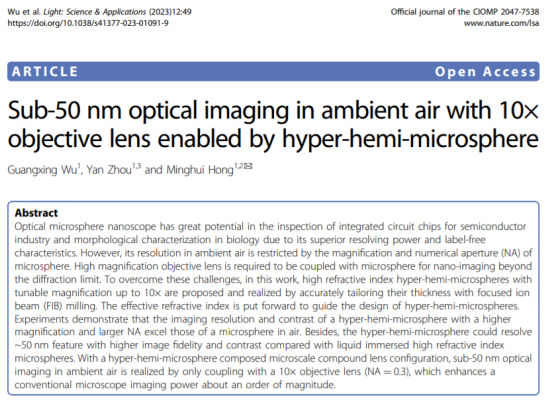
Recently, Professor Hong Minghui's team has proposed a novel microsphere lens assembly with special design and manufacturing, breaking through the requirement for high-resolution optical microsphere nano microscopes to be in liquid or solid immersion environments. They have achieved sub-50 nm microscopic imaging resolution in ambient air using a common magnification objective lens. The related achievements were published online on February 28, 2023, in the prestigious international journal Light: Science & Applications under the title "Sub-50 nm optical imaging in ambient air with 10× objective lens enabled by hyper-hemi-microsphere."
With the rapid development of the semiconductor industry, biomedical fields, and others, the demand for nanoscale morphology characterization of objects is increasing day by day. Optical microscopic imaging technology is favored in the field of micro and nano imaging due to its non-invasive, non-destructive, low-cost, and easy operation advantages. Traditional optical microscopes are limited by the diffraction effect of light, with a resolution limit of about 200 nm; to break through this physical limit, scientists have proposed a series of super-resolution optical microscopic imaging technologies over the past decades. Among them, optical microsphere nano microscopes, due to their nano imaging capabilities, no need for fluorescence labeling, real-time imaging, and high cost-effectiveness, are very competitive in the market. However, current optical microsphere nano microscopes are limited by their magnification and numerical aperture, and usually require observation in liquid or solid immersion environments to see sample structures at the sub-50 nanometer scale, which to some extent limits their application range. To break through these limitations and further improve imaging resolution, Professor Hong's team has researched a special design and manufacturing of a microsphere lens assembly that enhances the imaging resolution of traditional optical microscopes by an order of magnitude.
The team was the first to propose using a high-refractive-index micro-hyper-hemispherical composite lens instead of a conventional optical microsphere for magnifying the virtual imaging of nanoscale samples, and the magnified results can be resolved by a low magnification traditional optical microscope. In terms of design, considering the significant wave optical effects of the micro-hyper-hemispherical, an effective refractive index model was proposed to correct the geometric optics imaging theory, which can accurately and efficiently predict the imaging characteristics of micro-hyper-hemispherical composite lenses with different parameters. In terms of device preparation, a top-down approach using focused ion beam sculpting of high-refractive-index microspheres was proposed to manufacture micro-hyper-hemispherical, which is highly precise and universally applicable to microspheres of different materials.
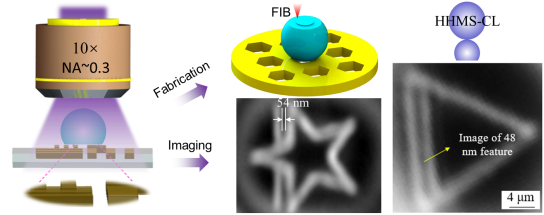
Imaging experiments have shown that compared with conventional optical microspheres, the micro-hyper-hemispherical has a larger numerical aperture and an adjustable magnification rate of up to 10 times. In the air environment, it can resolve sample structures close to 50 nanometers with just a 10x objective lens, and the image contrast and fidelity are higher than those of liquid-immersed microspheres. When assembled into a composite lens with a conventional microsphere, it can achieve a large field of view for sub-50 nanometer optical imaging. In addition, this technology has also been used to observe industrially manufactured CPU chips and has achieved good imaging results, confirming the practical potential of the technology. In summary, the micro-hyper-hemispherical composite lens technology proposed in this study has the advantages of high resolution, good imaging contrast, no need for fluorescence labeling, and no need for medium immersion. It has a broad commercial application prospect in the fields of chip quality inspection and biomedical research.
Professor Hong Minghui's team is one of the pioneers in the field of optical microsphere research, subverting the modulation capability of light in traditional optical devices, and providing a new way of thinking for constructing micro and nano optical systems, which has been highly praised by industry experts, including Nobel Prize winners. Based on this leading technology, Professor Hong Minghui incubated and established the Singaporean photonics technology company (Phaos Technology) as the chairman of the board of directors; the patented technology has been successfully transformed and established a strategic cooperation relationship with the world-renowned optical instrument manufacturer listed company Sigma Koki, successively launching a series of products, such as the optical microscope model OptoNano 200 exhibited at the 2020 Western Optoelectronics Exhibition in the United States, with a factory test indicator of 137 nanometers, subverting the traditional optical microscope perception and achieving significant social and economic benefits.
In August 2022, Professor Hong Minghui, an academician of the Singapore Academy of Engineering, joined Xiamen University as a full-time professor in the identity of Tan Kah Kee Chair Professor, aiming to build a global vision and a world-class micro-nano manufacturing and intelligent optical testing platform, focusing on Xiamen's "4+4+6" modern industrial system, actively promoting the landing of the "Photoelectric Island" project, and empowering the high-quality development of the inspection and testing industry.
The study was completed under the leadership of Professor Hong Minghui, in cooperation with the research team of Xiamen University and the National University of Singapore. Professor Hong Minghui, the dean of the Sa BenDong Micro-Nano Science and Technology Research Institute of Xiamen University, is the corresponding author of this paper, and Wu Guangxing from the Design and Engineering College of the National University of Singapore is the first author of this paper.
Full text link: [https://www.nature.com/articles/s41377-023-01091-9](https://www.nature.com/articles/s41377-023-01091-9)

